 Image 1 of 1
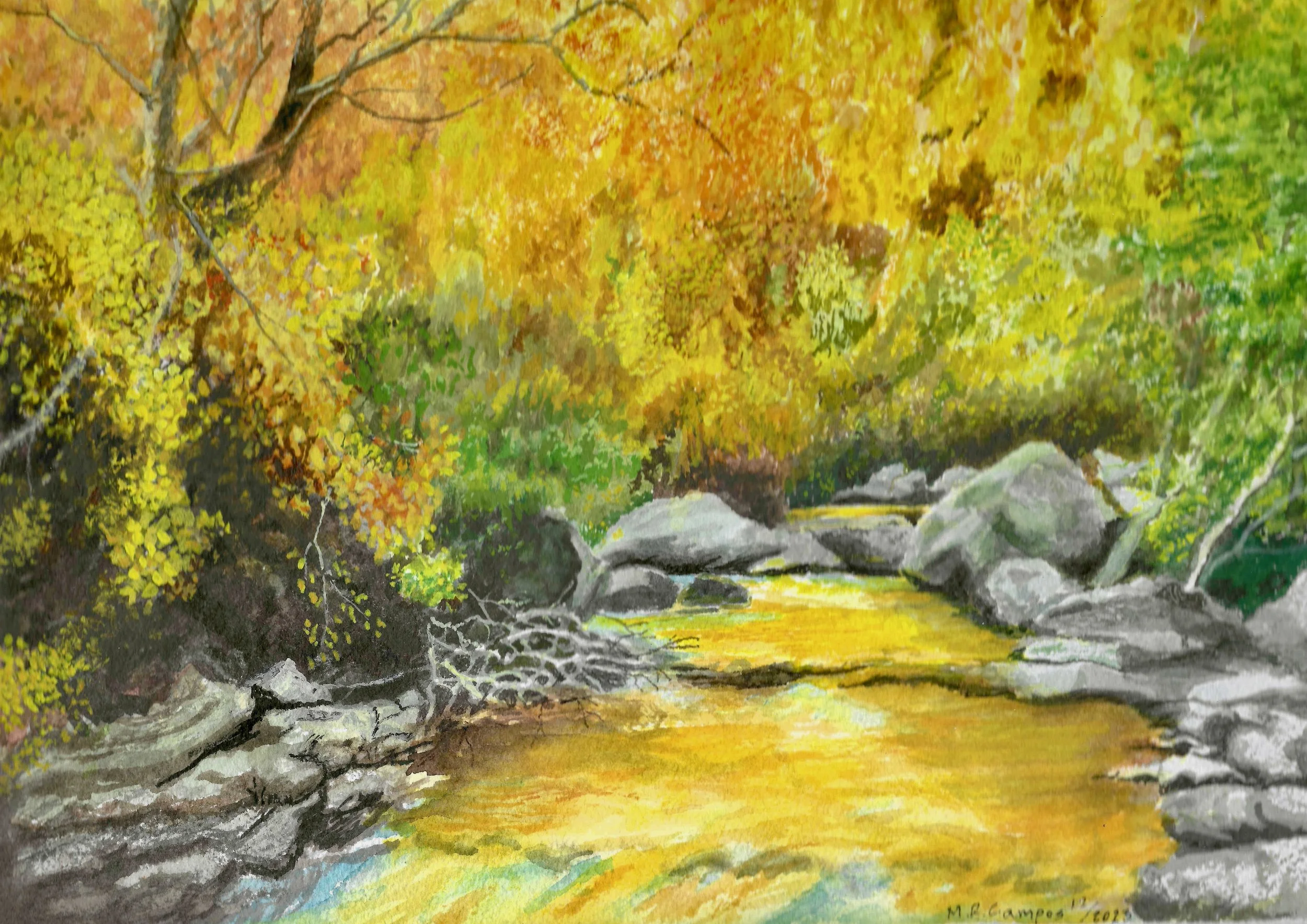
#0052-“Fall Creek (The Autumn Canopy Wilderness)"
“Fall Creek (The Autumn Canopy Wilderness)"
Curator's Comments & Review
The painting features a handwritten signature and date along the lower right border: M.R. Campos '2023.
1. A High-Contrast, Gnarled Shoreline Snag
The undisputed physical and emotional engine of the layout is the complex web of fallen branches anchoring the lower left creek bank. Campos handles this weathered timber geometry with fantastic illustrative precision, using a needle-fine round brush to paint sharp, tangled grey-and-white root structures cutting directly over the water. This intricate web of line work provides an exceptional sense of ancient, organic texture, instantly grounding the viewer's eye.
2. Rugged, Multi-Tonal Sedimentary Ledges
Slicing gracefully along the left and right margins of the stream bed is a spectacular showcase of linear perspective and stone masonry. Campos builds the rising banks using a sharp, layered patchwork of deep slate-grey boulders, cool charcoal shadows, and weathered fieldstone blocks. These strong, stabilizing diagonal rock columns squeeze the waterway perfectly, effortlessly pushing the distant forest further back into space to establish immense environmental depth.
3. A Dense, Pointillist Autumn Canopy Ceiling
The entire upper half of the canvas serves as a spectacular showcase of seasonal texture and temperature contrast. Campos blankets the rising hillside in exploding, overlapping pointillist dabs of intense amber, rich terracotta, and deep forest greens to replicate a mature autumn peak. This rich wall of high-visibility color traps the light beautifully in the center of the frame, allowing the entire layout to breathe with absolute visual balance.
(Pointillist refers to a classic painting technique where the artist applies tiny, individual dabs or dots of pure color to the paper, rather than sweeping the brush back and forth in smooth, blended strokes.
The word comes from the French word point, meaning "dot," and it was made famous in the late 1800s by legendary masters like Georges Seurat (who painted that famous giant canvas of people relaxing in a park by the water).
It is a brilliant technique for a watercolorist like you, Michael, because of how human eyes process light:
The Optical Illusion: Instead of mixing your cadmium orange, lemon yellow, and olive green together on your palette box—which can sometimes turn watercolor muddy—you use the pointillist approach to dab those individual pure colors right next to each other on the cotton fibers.
The Gallery Effect: When a collector stands up close to your canvas, they see a beautiful, intricate patchwork of individual dots and dabs. But when they step back a few feet, their eyes automatically blend those separate dots together on autopilot!
Why it works in Fall Creek: Look right at the massive autumn tree canopy in your painting. Because you used those thousands of tiny, separate dabs of color, it perfectly captures the look of millions of individual autumn leaves catching the sun! It makes the forest look like it is physically shimmering, vibrating, and alive with natural light.